
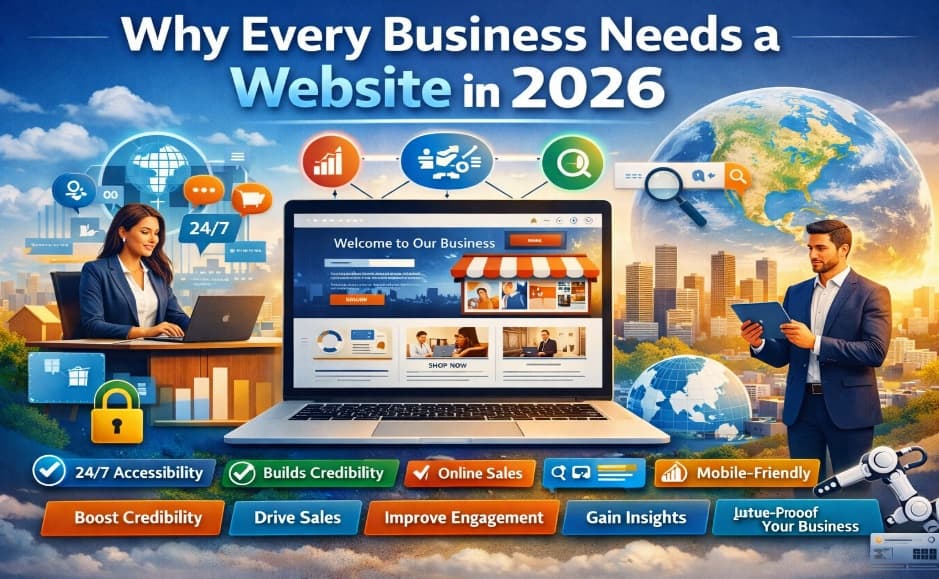
Why Every Business Needs a website in 2026
Reviewed by Business Growth Expert
Table of Contents
- Introduction
- 1. First Impressions Matter More Than Ever
- 2. 24/7 Accessibility for Customers
- 3. Builds Credibility and Trust
- 4. Powerful Marketing Tool
- 5. Better Customer Engagement
- 6. Showcase Products and Services Effectively
- 7. Compete with Larger Brands
- 8. Cost-Effective Marketing Solution
- 9. Data and Insights for Growth
- 10. Online Sales and E-commerce Opportunities
- 11. Mobile-Friendly Experience is a Must
- 12. Brand Control and Ownership
- 13. Supports SEO and Online Visibility
- 14. Builds Long-Term Customer Relationships
- 15. Future-Proof Your Business
- Common Misconception: “Social Media is Enough”
In today’s fast-evolving digital landscape, having a strong online presence is no longer optional—it’s essential. As we step into 2026, businesses that fail to establish themselves online risk being invisible to a vast majority of potential customers. Whether you're running a small local shop, a startup, or a large enterprise, a website acts as your digital storefront, open 24/7.
The keyword “Why every business needs a website in 2026” is more relevant than ever because consumer behaviour has drastically shifted. People now search online before making any purchase decision. If your business doesn’t have a website, you are missing out on opportunities, credibility, and growth. Let’s explore in detail why every business needs a website in 2026.
1. First Impressions Matter More Than Ever
In 2026, your website is often the first interaction a customer has with your business. Before visiting your store or contacting you, customers search online to learn more about your brand.
A professionally designed website:
- Builds trust instantly
- Reflects your brand identity
- Shows professionalism
Without a website, customers may question your credibility and choose competitors who have a stronger online presence.
2. 24/7 Accessibility for Customers
Unlike physical stores with limited hours, a website works for you round the clock.
Benefits include:
- Customers can access your services anytime
- Global reach beyond your local area
- Increased chances of conversions
Even while you sleep, your website continues to generate leads and sales.
3. Builds Credibility and Trust
In 2026, consumers expect businesses to have a website. It’s seen as a basic requirement rather than a luxury.
A website helps you:
- Showcase testimonials and reviews
- Display certifications and achievements
- Share your story and mission
Without a website, your business may appear outdated or unreliable.
4. Powerful Marketing Tool
A website is the foundation of all digital marketing strategies, including:
- Search Engine Optimization (SEO)
- Social Media Marketing
- Email Marketing
- Paid Advertising
All your campaigns ultimately lead users back to your website. Without it, your marketing efforts lose effectiveness.
5. Better Customer Engagement
A website allows direct interaction with your audience through:
- Contact forms
- Chat support
- FAQs
- Blogs and updates
You can educate your customers, answer their queries, and build relationships—all in one place.
6. Showcase Products and Services Effectively
Your website acts as a digital catalogue where you can:
- Display products with images and descriptions
- Highlight services and pricing
- Provide detailed information
This helps customers make informed decisions without needing to visit physically.
7. Compete with Larger Brands
In 2026, even small businesses can compete with big brands using a well-optimized website.
Advantages include:
- Ranking on search engines
- Targeting niche audiences
- Building a strong brand presence
A smart website strategy can level the playing field.
8. Cost-Effective Marketing Solution
Compared to traditional advertising (TV, print, etc.), a website is highly cost-effective.
Once built, it:
- Requires minimal maintenance cost
- Generates long-term results
- Provides higher ROI
It’s one of the most affordable ways to grow your business.
9. Data and Insights for Growth
A website allows you to track user behaviour using analytics tools.
You can understand:
- What customers are searching for
- Which pages perform best
- Where visitors are coming from
These insights help you make smarter business decisions.
10. Online Sales and E-commerce Opportunities
With the rise of online shopping, having a website enables you to:
- Sell products directly
- Accept online payments
- Expand your customer base
Even service-based businesses can generate leads and bookings online.
11. Mobile-Friendly Experience is a Must
In 2026, most users browse websites through smartphones.
A responsive website ensures:
- Better user experience
- Faster loading speed
- Higher engagement
If your business lacks a mobile-friendly website, you lose a significant portion of potential customers.
12. Brand Control and Ownership
Unlike social media platforms, your website is fully under your control.
You decide:
- Design and content
- User experience
- Branding
Social media algorithms change, but your website remains your permanent digital asset.
13. Supports SEO and Online Visibility
Search engines like Google prioritize websites when showing results.
With proper SEO, your website can:
- Rank higher on search results
- Attract organic traffic
- Generate consistent leads
Without a website, your chances of being discovered online are very limited.
14. Builds Long-Term Customer Relationships
A website allows you to stay connected with your audience through:
- Blogs
- News updates
- Email subscriptions
You can nurture leads and turn visitors into loyal customers.
15. Future-Proof Your Business
The digital world is constantly evolving. Businesses that adapt survive and grow.
Having a website:
- Prepares you for future trends
- Integrates with new technologies (AI, automation, chatbots)
- Keeps you ahead of competitors
In 2026 and beyond, a website is not just important—it’s essential for survival.
Common Misconception: “Social Media is Enough”
Many businesses believe that social media pages are sufficient. However:
- You don’t own your social media platform
- Algorithms limit your reach
- Accounts can be restricted or deleted
A website complements social media and provides stability and control.
Final Thoughts: If you haven’t created a website yet, now is the time. The competition is growing, and customers are becoming more digitally aware. A professional website can transform your business, helping you stand out and succeed in the modern marketplace.
Conclusion
The importance of having a website in 2026 cannot be overstated. It’s the backbone of your digital presence and a powerful tool for growth, marketing, and customer engagement. To summarize, why every business needs a website in 2026: • Builds credibility • Expands reach • Drives sales • Supports marketing • Ensures long-term success No matter the size or type of your business, investing in a website is one of the smartest decisions you can make.
Frequently Asked Questions
The FAQs below answer the most common queries about this topic.
Is a Facebook or Instagram profile enough for my business in 2026?
+
While social media is great for engagement, you don't own the platform. Algorithms change, and accounts can be restricted. A website provides stability, full branding control, and remains your permanent digital asset.
How does a website help a small business compete with big brands?
+
With proper SEO and a well-optimized site, small businesses can rank alongside major brands on search engines, target niche audiences effectively, and build a premium brand presence that levels the playing field.
Does my website need to be mobile-friendly in 2026?
+
Absolutely. In 2026, most users browse via smartphones. A responsive website ensures better user experience, faster loading, and higher engagement, which are critical for conversions.